
How Germany Lost the Technological Frontier
Or: What James Bond teaches you about Science Policy

This is the second essay in my series on the German Research System. You can read the first essay here. Each piece stands on its own.

In the James Bond cinematic universe, Q Branch exists solely to equip Bond with the tools he needs in the field. The invisible car, the exploding pen, the wristwatch laser: their value is entirely determined by whether they help Bond survive and succeed on his missions. But who decides in the real world what’s actual “cutting-edge” technology and, more importantly, what’s useful in the field?
To stick with the metaphor, national research systems should work similarly to Q branch: Universities, public labs, and publicly funded R&D organizations produce useful technical research that helps industry do its job, namely producing products. Obviously, Science, with a big S, is a noble pursuit and inherently valuable to mankind. But the justification for public research funding rests in large part on the return on investment. I expect my taxpayer money given to Q Branch (the R&D system) to equip Bond (industry) with useful technology that he applies in the service of his country. So, naturally, I should ask: Is Q Branch still building the gadgets Bond needs?
The answer for Germany appears to be: less and less.
Germany spent over €129.7bn (3.1% of GDP) on research and development in 2025. It operates one of the most elaborately structured public research systems worldwide: the Max Planck Society for basic research, the Fraunhofer Society for applied research, the Helmholtz Association for mission-driven research, and the Leibniz Association for everything in between. The system employs over 100,000 researchers across these four pillars alone, before counting universities. Yet, Germany dropped out of the Global Innovation Index top 10 in 2025, falling to rank 11. The reason is a decline in performance in “future technology” or what I call frontier (research) fields in this essay.
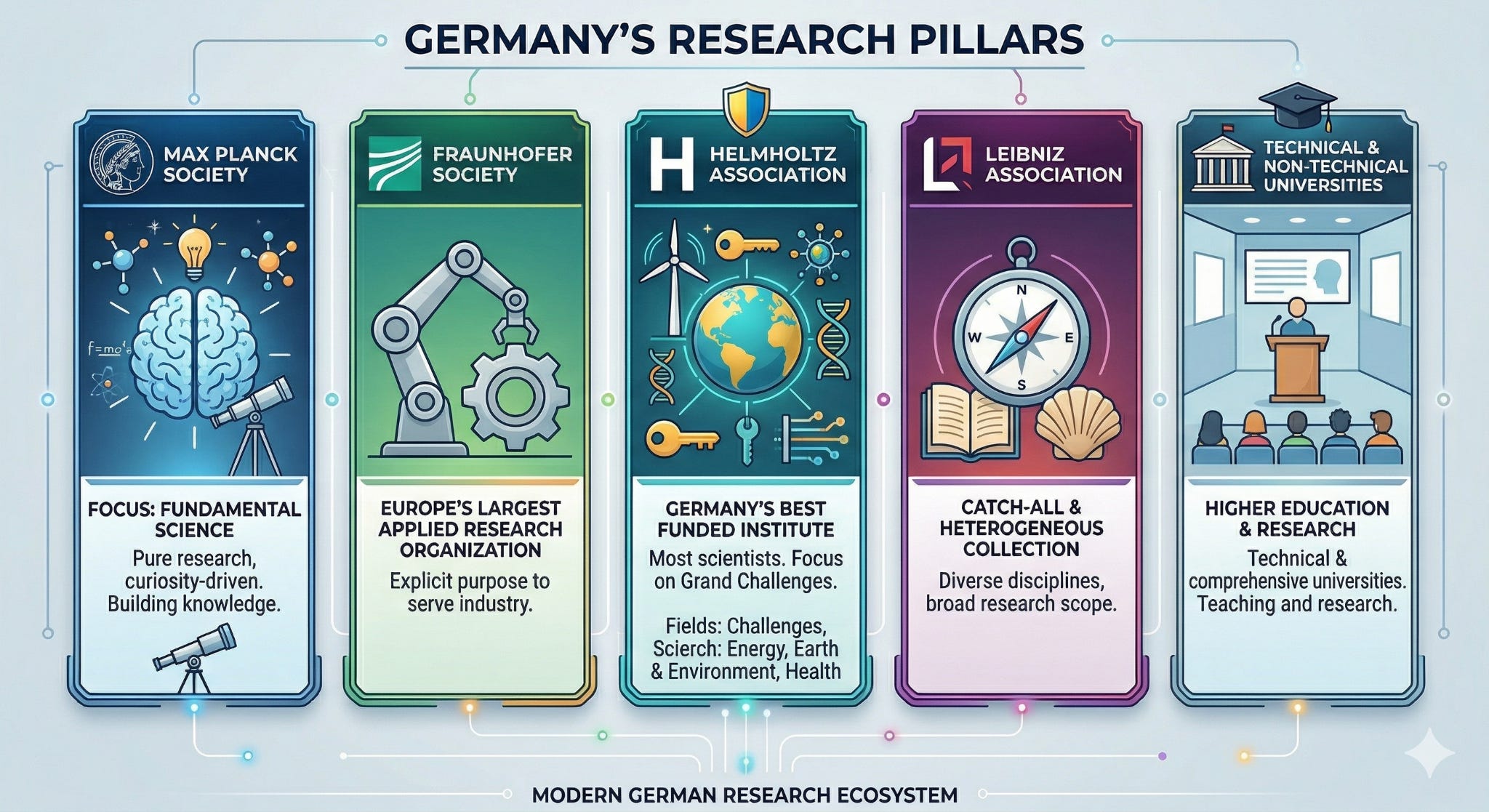
The German science system has three tasks: education, research, and innovation. I want to look at the link between research and innovation. And there, the purpose of public research is to equip industry with cutting-edge capabilities. If the research system is drifting away from the frontier technology domains, then Q Branch has a problem. Not because it’s doing bad science, but because it’s increasingly doing science that Bond doesn’t need.
But what are these frontier technologies? Anyone who has seen several James Bond movies, especially with different actors representing Bond over the decades, realizes that these frontier technologies are inherently time-bound. What was mission-critical for Sean Connery is little more than a vestige to Daniel Craig. Every era gets the Q Branch it needs. And Germany needs a different, more dynamic, and future-oriented Q Branch than its system currently allows.
Sticking with the James Bond metaphor one more time, the secret agent isn’t operating in a vacuum. He’s constantly competing or collaborating with foreign powers – both states and rogue actors – and must outmatch them and their technology. Fortunately, the public research system doesn’t have to match classified research. We can compare the frontier research fields of nations or international bodies with each other based on their stated policies.
So I looked at the policies of
China (15th five-year-plan, 2025),
the USA (CHIPS and Science Act, 2022),
Germany (Technological Sovereignty, 2025),
Europe (Horizon Europe, 2021), and the
OECD (STI Outlook, 2025)
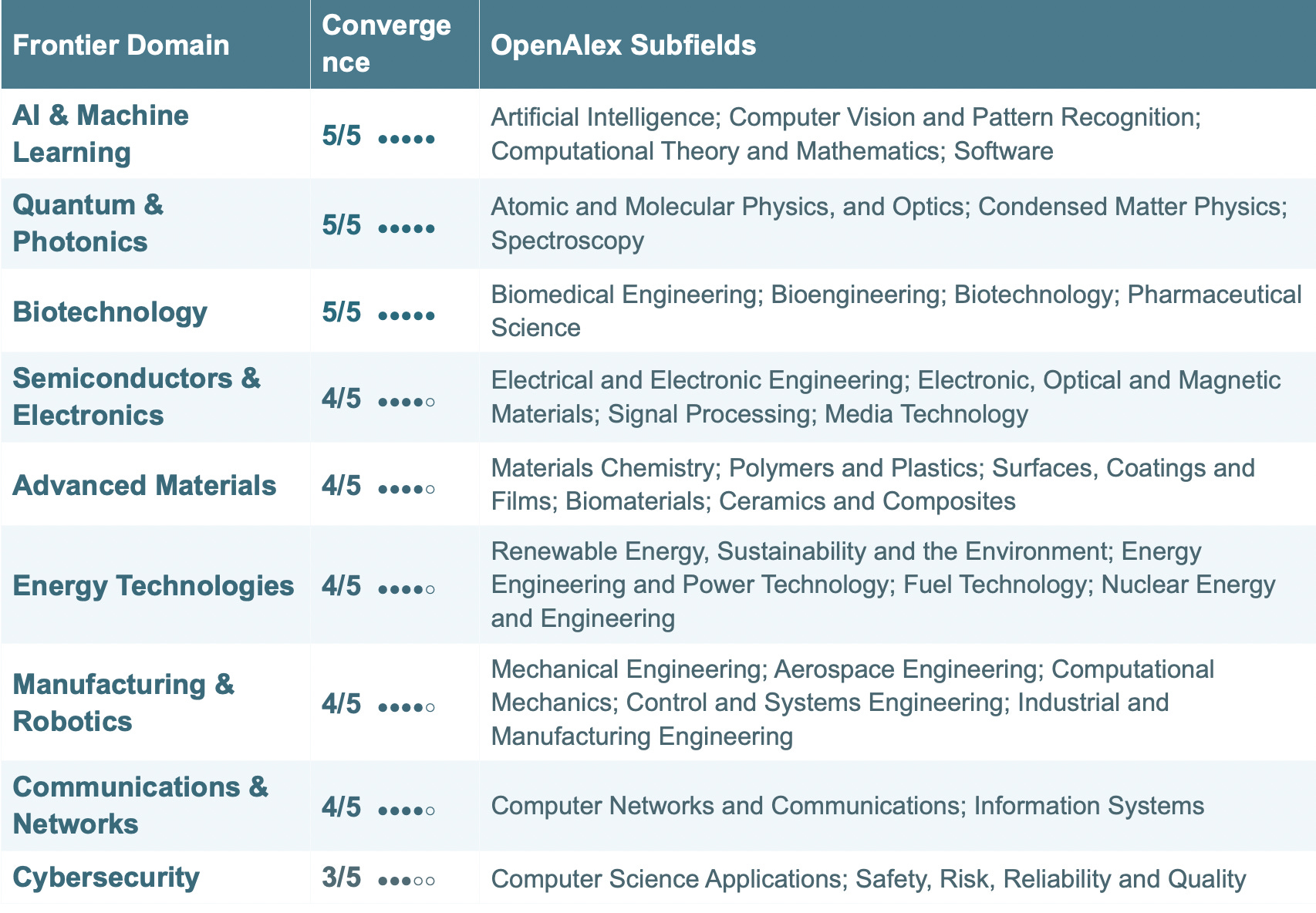
You’d expect them to agree that some technologies are so important to justify federal investments in domestic research and development, supply chains, and factories. For me, if at least three of the five frameworks flag a research or technological field, it’s a frontier field. This ensures the classification reflects a broad international consensus rather than any single country’s political agenda.
This is what the policies agree on: The AI revolution requires AI & machine learning capabilities and the semiconductors to run on, new energy technologies to power it, and advanced materials, manufacturing, and robotics to build it. Nations have to keep their citizens healthy (biotechnology), connected (communications), and digitally safe (cybersecurity). Also, every policy bets on quantum computing as a viable next computing paradigm.
Traditional science domains are more forgiving regarding the distance between “basic research” and market-ready products. An astrophysicist usually doesn’t have pressure to develop a cost-efficient satellite for their research. A pure mathematician doesn’t need to prioritize the application value of their theorems. It would be better if the distance were short, sure, but it usually isn’t when deciding a market leadership position. In AI research, it does. In the frontier fields, especially, the boundary between basic and applied research is blurred or nonexistent. In artificial intelligence, a new model architecture is simultaneously a product. In synthetic biology, the discovery of a gene-editing mechanism is indistinguishable from the creation of a biotechnology tool.
This asymmetry is what makes frontier technology domains the right test case for evaluating research architectures. This means that if a system that enforces separation between basic and applied research imposes costs, those costs should be most evident in frontier domains. And the German research system is essentially derived from the linear model of science, which assumes that basic research leads to applied research, which in turn leads to products. It separates the responsibilities for basic research, applied research, and large research institutions.
The Max Planck Society is Germany’s flagship institution for basic research. It operates 84 institutes with roughly 24,000 employees, funded almost entirely by the federal and state governments. The mandate is explicitly to pursue research that universities cannot or will not undertake: high-risk, long-horizon, curiosity-driven science.
The organizational principle is the “Harnack principle,” named after Adolf von Harnack, its first president.1 The idea is simple: identify outstanding scientists, give them maximum resources and freedom, and let them define their own research agenda. In practice, this means institutes are built around powerful, life-tenured directors who run their operations with near-total autonomy.
This structure has produced extraordinary science. Max Planck researchers have won numerous Nobel Prizes, and the Society consistently ranks among the world’s top research institutions. Max Planck’s strength is its weakness in the context of frontier technology. The institution is designed to let brilliant people follow their curiosity. That is genuinely valuable, as some of the most important discoveries in history came from curiosity-driven research with no foreseeable application. But when frontier fields like AI and semiconductor design require the simultaneous integration of fundamental science and engineering application, an institution that defines itself by its distance from application is structurally limited in what it can contribute.
The Helmholtz Association is Germany’s largest research organization: 18 research centers, approximately 46,000 employees, and a budget of roughly €6 billion. Helmholtz operates machines that no one else can afford, such as particle accelerators, research reactors, supercomputers, satellite systems, and icebreaking research vessels.
The Association is organized into six research areas: Energy, Earth and Environment, Health, Information, Matter, and Aeronautics, Space and Transport. Funding comes predominantly from the federal government (90%) and state governments (10%), with additional project funding from competitive grants.
This sounds like Helmholtz should be the natural home for frontier technology research—and in some domains, it is. The German Aerospace Center (DLR) and the Karlsruhe Institute of Technology (KIT), both Helmholtz members, do significant work in energy technologies, advanced materials, and information science. Helmholtz centers were central to Germany’s early investments in AI and quantum computing.
But the frontier is increasingly moving toward fields where the advantage comes not from scale but from speed: AI, software-defined biotech, advanced materials discovery. These are domains where research directions can shift within months, where a three-person team with access to compute can leapfrog an entire institute, and where the bottleneck is talent and iteration, not instruments. Helmholtz’s own leadership admitted in its 2023 annual report that advancing AI and data science expertise is “the central challenge for the entire association.”
The Helmholtz Foundation Model Initiative, launched in 2024, allocated €23 million for AI across the organization. For a €6 billion institution that calls AI its central challenge, that is 0.4% of annual budget directed at what its own leadership considers its most important problem.
On top of that, Helmholtz struggles with mission lock. The very thing that makes Helmholtz powerful — massive, purpose-built infrastructure — also makes it slow to redirect. Its research is organized in multi-year program cycles negotiated with the government, which provides stability but limits rapid reallocation as technological priorities shift. In frontier domains such as AI or advanced materials, where research directions can evolve within months, this temporal rigidity may create a lag between emerging technological bottlenecks and institutional response. Speed of iteration matters as much as scale.
Helmholtz’s frontier technology share in the Nature Index (a metric looking at the number of publications in prestigious journals like Nature) dropped from 36.4% to 32.4% between 2014 and 2024, even as its total publication volume grew by 57.4%. The association is producing more research, but a shrinking proportion of it falls in the domains that every major policy framework identifies as strategically critical. Helmholtz’s infrastructure intensity may bias research toward capital-intensive and instrument-compatible domains, rather than toward those currently experiencing the fastest conceptual breakthroughs (e.g., parts of AI).
The Fraunhofer Society is the part of Q Branch that’s supposed to be closest to Bond — the applied research arm that translates scientific knowledge into products and processes industry can actually use. It operates 76 institutes with roughly 32,000 employees and an annual budget of €3.6 billion. It is Europe’s largest application-oriented research organization.
To understand what Fraunhofer does, you have to understand how it’s paid. The so-called “Fraunhofer model,” formalized in 1973, splits funding into three roughly equal pillars: about 30% comes as institutional base funding from federal and state governments, and the remaining 70% must be earned through direct industry contracts, license fees, and competitively acquired public-sector project funding. In 2024, direct industry contracts contributed €705 million, and license fees added another €162 million.
The critical mechanism is this: the 30% base funding is dynamically tied to success in securing the 70% contract funding. If an institute fails to win industry contracts, its base funding shrinks. Fraunhofer’s own language frames this as a feature: the pressure to acquire contracts “fosters entrepreneurial thinking and activities.” And that’s true. Fraunhofer institutes are genuinely entrepreneurial. They pitch actively, they maintain close relationships with industry partners, and they produce real economic value. Patent output increases measurably in cities with established Fraunhofer centers.
But this entrepreneurial pressure has a structural consequence that matters enormously for frontier technology. Because Fraunhofer must earn 70% of its budget from external sources, its research portfolio is determined by who is willing to pay. And who is willing to pay, overwhelmingly, is Germany’s existing industrial base: automotive, mechanical engineering, chemicals, and manufacturing. These industries want incremental innovation, like making a combustion engine 2% more efficient, optimizing a production line, or improving a surface coating. They rarely commission research into entirely new technology paradigms.
The U.S. National Academies studied Fraunhofer in depth and concluded that the model “emphasizes performance of a large number of short-term research projects that have near-term commercial impact,” an approach which “reinforces the German method of incremental innovation.” The same report found that because Fraunhofer’s business model is based on demand from existing industries, it has little economic incentive to pioneer entirely new industries.
This creates a feedback loop. Germany’s industrial base is concentrated in legacy sectors. Those sectors fund Fraunhofer to improve their existing products. Fraunhofer delivers incremental improvements. The incremental improvements sustain the legacy sectors for another cycle. Meanwhile, no major domestic AI industry or quantum computing sector exists to commission frontier research from Fraunhofer.
Fraunhofer allocates its 30% base funding to “pre-competitive research”—work meant to anticipate what industry will need in 5–10 years. But even this forward-looking component tends to orbit existing client relationships and sectoral strengths. Fraunhofer’s own description of its primary customer base is telling: “large and medium-sized companies that utilize its expertise to boost their competitiveness with new technologies.” Boost existing competitiveness, not create entirely new competitive domains.
The problem is not that Fraunhofer does bad work. It does excellent work for the industries it serves. The problem is that the funding mechanism makes Fraunhofer a mirror of Germany’s existing industrial composition. When that composition is misaligned with frontier technology fields, Fraunhofer amplifies the misalignment rather than correcting it. It is, in effect, the research system’s procyclicality problem: the institution designed to be closest to the market inherits the market’s blind spots.
Fraunhofer did tremendous work when Germany had the dominant frontier technologies: cars, chemistry, and pharma. But the missing dynamism in German industry means the Fraunhofer model can only do so much to innovate in frontier technologies. To be explicit: The problem for Fraunhofer Institutes is the lack of dynamism in industry, driven by market incentives such as labor laws, energy prices, and venture capital.
Each pillar isn’t particularly well-suited to producing frontier technology for its own reasons. Max Planck is too far from application. Helmholtz is locked into infrastructure that can’t pivot. Fraunhofer is chained to the demands of an industrial base that is itself falling behind. Even if any of them would produce breakthroughs in the frontier fields, the structural decoupling of the pillars prevents a smooth handoff between the R&D parties.
The entire German research system is built on what the innovation literature calls the linear model: basic research produces discoveries, which are handed to applied researchers, who hand them to industry. Each institution has a lane: Max Planck discovers. Fraunhofer translates. Industry produces. The logic is tidy, and for decades, it worked because German industry was at the frontier. When BMW, BASF, and Siemens were world leaders in their domains, the handoff had somewhere useful to land. Fraunhofer’s demand-driven model pulled applied research in the right direction because the demand itself was frontier-relevant. Max Planck’s distance from application was less costly because the fields that mattered, such as chemistry, materials science, and mechanical engineering, tolerated it.
That era is over. In frontier fields, the handoff model has no basis in how research actually works. The economics of innovation literature rejected the linear model decades ago. Stokes (1997) showed that the most productive research often lives in what he calls “Pasteur’s Quadrant”. This quadrant is a zone where use-inspired inquiry and fundamental discovery happen simultaneously, named after the French chemist, pharmacist, and microbiologist. Shamelessly plugged from Wikipedia:
He’s “renowned for his discoveries of the principles of vaccination, microbial fermentation, and pasteurization, the last of which was named after him. His research in chemistry led to remarkable breakthroughs in the understanding of the causes and prevention of diseases, which laid down the foundations of hygiene, public health and much of modern medicine. Pasteur’s works are credited with saving millions of lives through the developments of vaccines for rabies and anthrax. He is regarded as one of the founders of modern bacteriology and has been honored as the “father of bacteriology” and the “father of microbiology”
Pasteur was a true tinkerer and frontier scientist. Several times, he switched his area of research from physics to chemistry to microbiology, discovering immunology and developing vaccinations and germ theory. In today’s German system, he’d have one hell of a time receiving a position to even start one of his breakthroughs. The system isn’t set up for a polymath like him to thrive, explore his interests broadly, and apply them immediately. He’d be a wonderful Quartermaster, though.

The model that underpins Germany’s four-pillar system is one that academic studies of innovation have considered obsolete since the 1990s. Aghion, Dewatripont, and Stein (2008) formalized the underlying trade-off: the cost of separating researchers from commercial applications depends on how close the research is to the market. When research is far from commercialization, academic autonomy works fine. When research is close to market, firm control is more efficient. In AI, biotech, and semiconductors — the fields every major policy framework on earth identifies as strategically critical — the distance between research and market has collapsed to near zero. The German system was designed for a world where that distance was large.

Germany still trains highly talented researchers and boasts stellar funding. It did drop out of the Global Innovation Index top 10, nonetheless, because the architecture of its research system produces excellent work in fields that are decreasingly relevant to industrial competition and is structurally incapable of pivoting toward the fields that are.
When the frontier was automotive engineering, precision manufacturing, and industrial chemistry, Fraunhofer’s demand-driven model pulled research in the right direction because the demand came from world-leading firms. Max-Planck could focus on other research fields and was much more successful because, in part, the ideas that led to groundbreaking technologies were easier to identify from a purely basic research vantage point. Today, ideas are getting harder to find. With it, the demands for national research systems rise.
The problems of the twenty-first century don’t fit neatly in a tidy linear model from the 20th century. Germany’s research system has a structural gap where Pasteur’s Quadrant should be. No institution in the four-pillar system is designed to occupy the space where use-inspired fundamental research–the likes of Q Branch in the James Bond universe–happens. The most fertile zone in modern innovation has no institutional home in Germany.
Technically, he was the president of the Kaiser Wilhelm Society, which was the initial name before the entire system was restructured into today’s MPS and renamed after WWII.
This turned out fantastic! Thanks for writing this. I had no idea about the German research ecosystem.
Interesting. At first I thought this was going to be "Germany's R&D Institutes are each following a Gradient Descent algorithm, and ending up in local minima (as might be expected): the answer is to add Simulated Annealing". But you are calling for a bigger shake-up than that, if I understand correctly.